It was really time to get moving now as we had to check
out of Indonesia by the 27 October, before our visa ran out, and we still had so many
nautical miles to travel. We left Kumai River and motored out through the smoke
haze avoiding ferries, fishing boats and cargo ships. All we can say is thank
you for radar.
We were headed west to two islands, Palau Belitung
and Palau Bangka, off the east coast of Sumatra. It was a long trip so we
stopped at Palau Gelam, off the west coast of Borneo, for four hours sleep before continuing
to Manggar, Belitung. These two islands were official rally stopovers with scheduled
festivities but by the time we arrived the festivities in Manggar were over and the rally
boats had departed that morning. It was a rolly anchorage so we got what sleep
we could manage and left before light at 0500 hours the next morning, and sailed to the North West coast of Palau
Belitung.
We struggled all day to get
enough winds to fill the sails but one hour before arriving in the scheduled anchorage
the wind piped up to 19 knots. There were a few terse words but we finally
dashed the sails while trying to avoid 22 fishing boats heading out for the
night, shallow seas and granite boulders, all in fading light.

But the anchorage was well worth it. It was sheltered, had great amenities ashore, good restaurants, friendly locals and beautiful scenery. What more could you ask for really. The place was reminiscent of sailing around Virgin Gorda, in the British Virgin Islands, as the water was warm and crystal clear, and there was huge granite boulders everywhere linked with white sand beaches. Paradise.
The locals put on a two welcome ceremonies and the food was lovely. We were also given a free Indonesian cooking class which was so much fun for the local women and us too. Trying different foods, finding similar foods and using them in a different way or with different techniques was extremely enjoyable for all who participated and all done without a common language. We had lots of photos and laughs while cooking and sharing the food.
We spent the three days snorkelling, swimming and having sundowners on the beach. Palau Belitung ended up being a favourite stopover for us and we really did not want to leave. We found that this place gets a lot of domestic tourism but we only found one other westerner that had made the long pilgrimage here. Given the picturesque nature of the place and along with the modern conveniences, I doubt if it will remain undiscovered for long.
Ever onward we pressed north and had our longest sail with no motoring for over three months, with perfect wind conditions. Fifteen hours later we arrived at the little island of Ketawai, off the east coast of Palau Bangka. Normally, an uninhabited island, Bangka Officials decided to move everything and the kitchen sink here, to set up a base for the Sail Indonesia rally boats. Before we arrived several boats came over with staff and set up about 20 tents to accommodate all the people who would look after us for four days with all the necessities of life - Officials, Police, volunteers, cooks, and musicians.
The four days were jam packed with activities. The staff supplied us with three meals a day. Peter and I used to stay on the boat until mid-afternoon, if there was no planned activity. But you could really just stay on the island, sun up to sun down and the staff would look after you.
After dinner in the evening we would have musicians entertaining us and one evening we even had a game of football. The locals versus the sailing crew. It was pitch black with no lighting but that did not stop the game taking place. The balls were actually coconuts dipped in fuel and then lit. We all sat around the perimeter of the sand field while the teams battled it out. The locals were very good and had the obvious advantage being used to playing in the dark, with a burning ball and bare feet. The ball was very hard and of course very hot but you only touched it for a few seconds so it did not result in any serious burns. Our team redeemed itself when a few of the girls joined in, with Sarah (Sea Monkey) scoring a great goal.
Two of the four days there were day long planned activities. The second day they took us all on three boats over to Palau Bangka.
Here we all boarded into three buses and went to see the highlights of Bangka. We were taken by Police escort to a primary school where the children performed a dance for us and then it was off to the Local Government offices where we were greeted by the Mayor with a welcome speech and a meet and greet with all the officials.
For lunch we were taken to a silted house located in the middle of a rice paddy field where we were all treated to a lovely nine course meal. The food was scrumptious and we also got to try a locally made non-alcoholic rice drink. It was very unusual but also very nice, so a lot of the sailing fraternity bought several bottles to take home. We had exhausted their supply by the time we left. Then to walk all that food off we went on a small bush walk through a small patch of remanent forest.
The highlight of the day would have to be in the afternoon. We were taken to a field where a stage was set up with a band. After the welcome and music we watched some very talented locals give a performance of the types of games, played at what was described as a mini Olympic Games. Teams from various parts of Palau Bangka come yearly to take part in the games. First a race between two teams.
One player from each team would lie on a narrow wooden bench with a wheel. He was pushed at great speed by his team member around various obstacles. First over a wooden mat, then swerving in and around bamboo baskets and finally through the middle of a split wooden pole. If any of this was not performed correctly, or in the incorrect order then a referee would make the team perform the task again.
 |
| Stunning. |
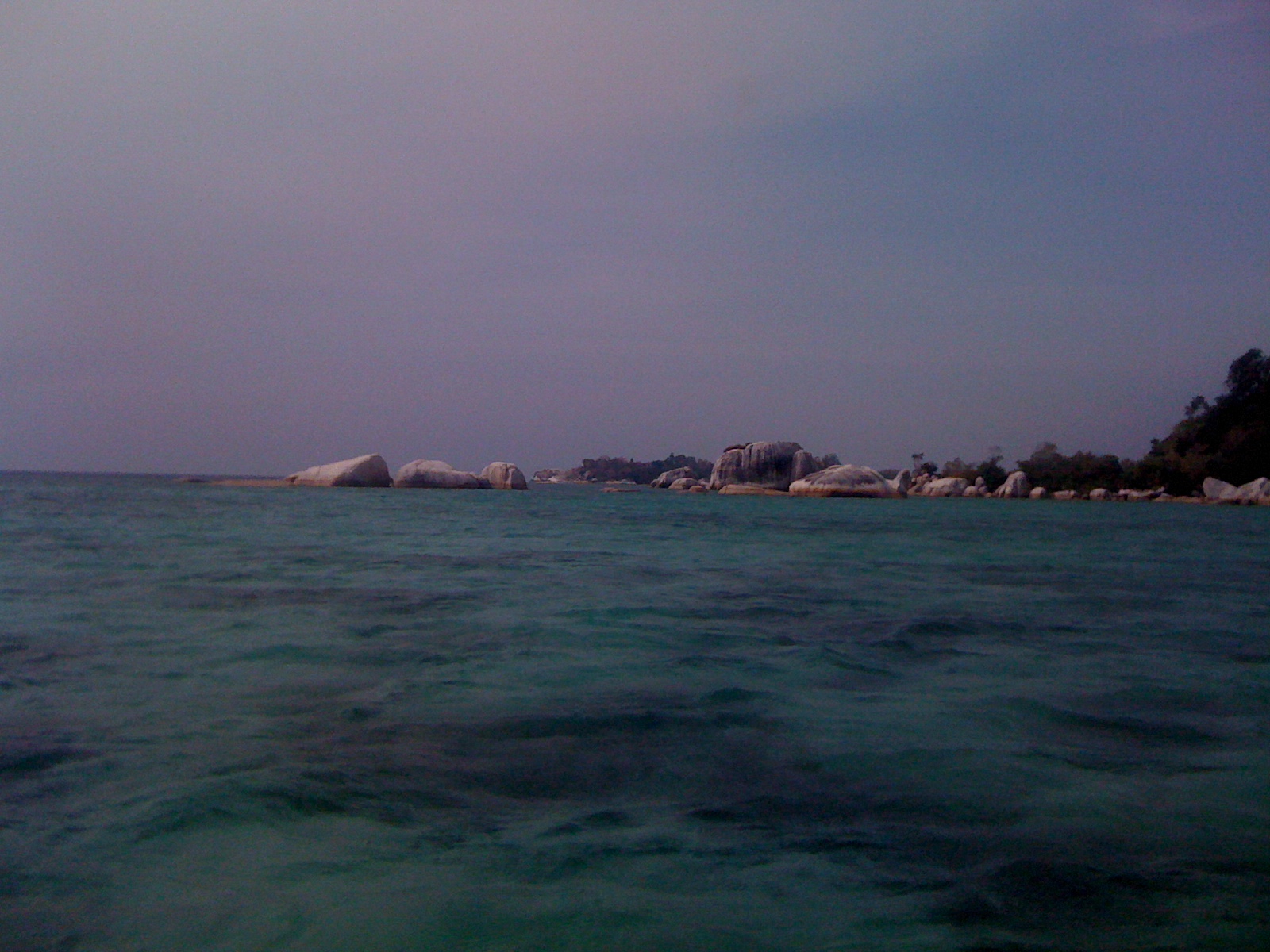
But the anchorage was well worth it. It was sheltered, had great amenities ashore, good restaurants, friendly locals and beautiful scenery. What more could you ask for really. The place was reminiscent of sailing around Virgin Gorda, in the British Virgin Islands, as the water was warm and crystal clear, and there was huge granite boulders everywhere linked with white sand beaches. Paradise.
The locals put on a two welcome ceremonies and the food was lovely. We were also given a free Indonesian cooking class which was so much fun for the local women and us too. Trying different foods, finding similar foods and using them in a different way or with different techniques was extremely enjoyable for all who participated and all done without a common language. We had lots of photos and laughs while cooking and sharing the food.
 |
| It's hard work but someone has to do it. |
We spent the three days snorkelling, swimming and having sundowners on the beach. Palau Belitung ended up being a favourite stopover for us and we really did not want to leave. We found that this place gets a lot of domestic tourism but we only found one other westerner that had made the long pilgrimage here. Given the picturesque nature of the place and along with the modern conveniences, I doubt if it will remain undiscovered for long.
 |
| Our dinghies clutter the shore. |
Ever onward we pressed north and had our longest sail with no motoring for over three months, with perfect wind conditions. Fifteen hours later we arrived at the little island of Ketawai, off the east coast of Palau Bangka. Normally, an uninhabited island, Bangka Officials decided to move everything and the kitchen sink here, to set up a base for the Sail Indonesia rally boats. Before we arrived several boats came over with staff and set up about 20 tents to accommodate all the people who would look after us for four days with all the necessities of life - Officials, Police, volunteers, cooks, and musicians.
 |
| Impromtu dance and music by the volunteers. |
The four days were jam packed with activities. The staff supplied us with three meals a day. Peter and I used to stay on the boat until mid-afternoon, if there was no planned activity. But you could really just stay on the island, sun up to sun down and the staff would look after you.
After dinner in the evening we would have musicians entertaining us and one evening we even had a game of football. The locals versus the sailing crew. It was pitch black with no lighting but that did not stop the game taking place. The balls were actually coconuts dipped in fuel and then lit. We all sat around the perimeter of the sand field while the teams battled it out. The locals were very good and had the obvious advantage being used to playing in the dark, with a burning ball and bare feet. The ball was very hard and of course very hot but you only touched it for a few seconds so it did not result in any serious burns. Our team redeemed itself when a few of the girls joined in, with Sarah (Sea Monkey) scoring a great goal.
Two of the four days there were day long planned activities. The second day they took us all on three boats over to Palau Bangka.
 |
| The school children performing for us. |
Here we all boarded into three buses and went to see the highlights of Bangka. We were taken by Police escort to a primary school where the children performed a dance for us and then it was off to the Local Government offices where we were greeted by the Mayor with a welcome speech and a meet and greet with all the officials.
 |
| Katrina blazing the trail. |
The highlight of the day would have to be in the afternoon. We were taken to a field where a stage was set up with a band. After the welcome and music we watched some very talented locals give a performance of the types of games, played at what was described as a mini Olympic Games. Teams from various parts of Palau Bangka come yearly to take part in the games. First a race between two teams.
 |
| Pushed fast around the bamboo baskets. |
 |
| Slowly through the split log to avoid a spill. |
It was virtually impossible to keep the 'bike' upright, and a wobble would result in one or two players on the ground. When this occurred the referee would then make them go back to the beginning and start again. It had so many spills and thrills the audience were in fits of laughter.
 |
| A happy audience. |

Then we had a exhibition of how to play with a spinning top. Long strands of a bamboo rope were tightly wound around a large top. It was then thrown from hip height out in front of each player. The rope quickly comes undone and if performed correctly the top lands upright on the ground and spins. The team who has the longest upright spinning top - wins.
Many of the Sail Indonesia rally boys had a go at this and after a few goes got the hang of it and performed well against the locals. This much impressed our hosts.
 |
| A local home. |
On Day four we were taken by boats again to a small isolated islet where several fishing famalies live. They stay on this island fishing for several months of the year and with pretty basic accommodation and amenities, life for the occupants seems quite desolate. A woman had given birth the day before and was nursing a one day old child.
 |
| Bags of goodies for the locals. |
Most boats on the Sail Indonesia rally had come prepared with all sorts of goodies for isolated Indonesian villages like this. You should have seen the happy faces especially when the children were given colouring in books and coloured pencils. Though the biggest smiles from the children was when they were given a soccer ball.
 |
| Robby with the local kids - the soccer balls and lollies were a big hit. |
On the last day we all celebrated together and were officially checked out of Indonesia. Most of the boats had elected to check out in Bangka as the marina at Nongsa Point was numerous nautical miles away and most boats would not make it by the time their visas expired. Not to mention that the marina there too was going to charge a large fee to organise the whole process.
All our passports had been taken by boat to Bangka Island and were processed in Bangka within two days and brought back to us by the last day, all free of charge. It was all so easy here and so unlike our experience in Lombok, where we were charged a large sum of money to get our passports to the Embassy and then wait eight days for the process to be complete. We thought of how different the experience can be in different locations within the same country.
 |
| My little turtle hatchling. |
Formalities over with, we all could relax and enjoy the last scheduled event at Ketawai, which was the release of a large number of turtle hatchlings. It was a fantastic idea and it was really enjoyable for adults and children alike.
Really northern Indonesia pulled out all the stops to welcome us and showed us a fantastic time. This area does not see much tourism compared with islands down south, so I think they were keen to show that they can be a great tourist region if given the chance. So a big shout out to all who read this - next time you think of a holiday in Indonesia consider the north, as it really has a lot to offer.