Monday, 7 September 2015

31) Central Indonesia: Sumbawa Island to Lombok Island. 7 to 15 September 2015.


What we had found since leaving Alor Island in the east was days of motoring, as this time of year the winds are predominantly from the S to SE and the northern coastal route to the west we had been taking, was quite sheltered and calm so far.


Sumbawa Island is a large island which has a long wind exposed north coast which helped give a bit of breeze and we were at least able to sail sometimes or at the very least motor-sail.


The sad thing about Sumbawa Island is the extreme poverty. It was the poorest island we had been to so far and it was gut-wrenching to see it. Generally Indonesia is a very poor nation, with the exception of places that see a lot of tourism (notably Lombok and Bali) or have enough commercial activity (Java) to sustain most of the population. The rally participants that I know of went out of their way to buy things from places that did not see much cash flow. Spreading the love as it was known. For example buying fuel if available, vegetables or souvenirs from smaller villages or towns. Obviously supermarket items were only ever available in more commercial or larger towns.

Items were very cheap when compared to what we pay for things in the west. For one Australian Dollar you received about 10,000 Indonesian Rupiah. So going to the market you would roughly get 500 g of tomatoes for about 5000 Rupiah (50 cents). Several eggplants or cucumbers were 5000 Rupiah or a luxury like pineapple, 15,000 rupiah ($1.50). So we made a point of buying vegetables a lot and from smaller towns, plus the availability of refrigerated meat was limited to supermarkets. Non-refrigerated fish and sometimes chicken were available at wet markets which some of the fleet resorted to or others became vegetarians. Lucky for us with our huge freezer, two fridges and large storage areas we still had 3 to 4 months’ worth of meat, cheese, butter, chocolate and alcohol, as we had heeded the warning ‘you really need to stock up’.
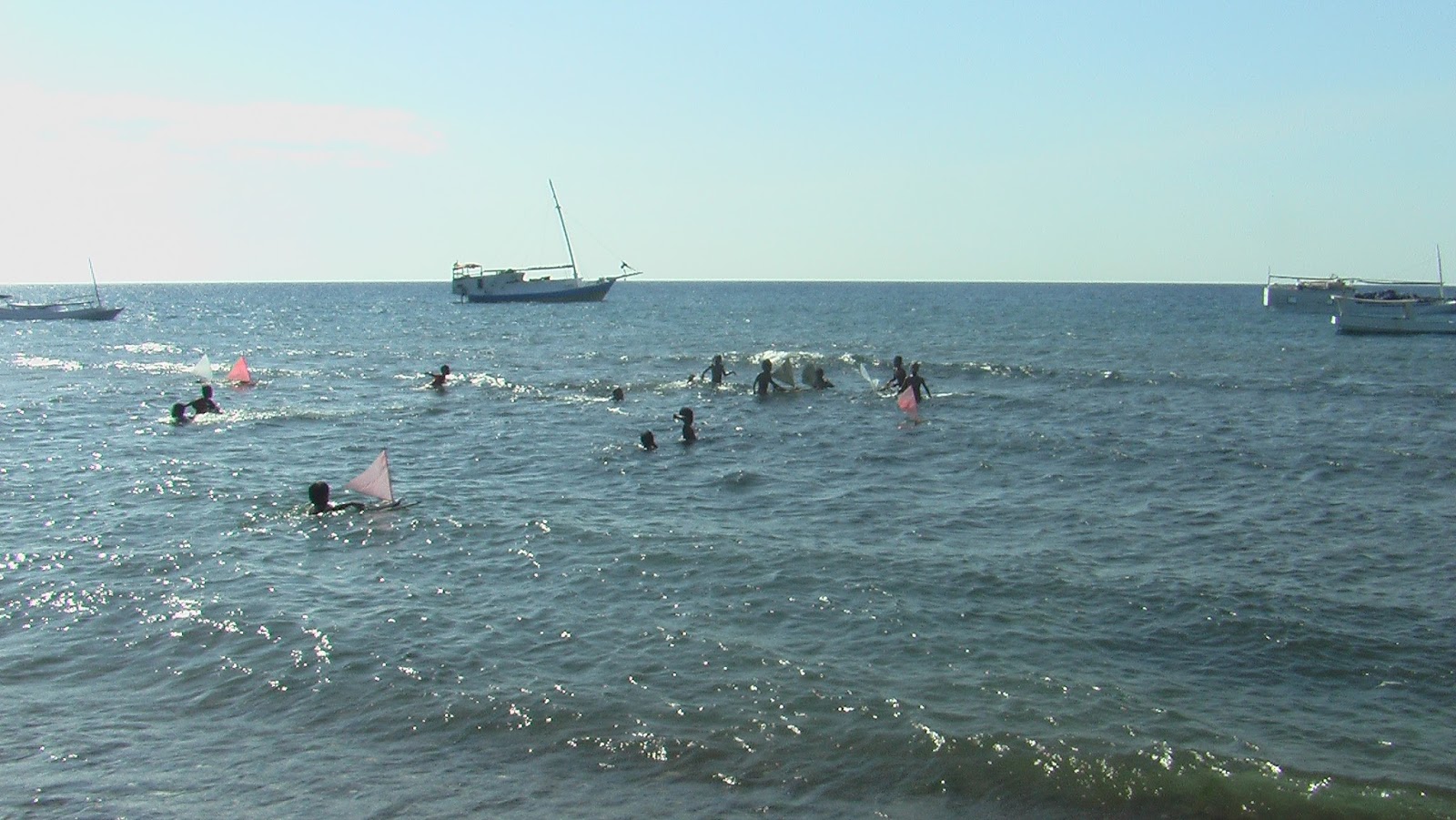

Children playing with their replica boats.

One of the places we really enjoyed seeing on Sumbawa Island was Wera. Here there is a thriving enterprise of boat building. We were able to anchor just offshore and dinghy right to the beach where all the boats are made, passing the young boys in the surf playing with their hand made replica boats. 


Boat building - Wera style.


Then we walked amongst the monsters being built on the beach. They are all hand made from wood with little or no machinery. Electricity and electric tools were extremely limited. 


We didn’t understand much of the process as no one could speak English. We were able to understand that one of the boats had taken about two years to get it to the stage we saw, which looked about half finished. For the amount of effort and the look of the town I don’t think they were being paid much for producing the boats.


Scaffholding?

The four of us wondered about the seemingly missed opportunity. We would have been happy to pay $1-3/head for someone to show us through the boat building site and explain the process. Also we hunted everywhere for the small replica boats the children played with, but none were available to buy. 


Lucky for the town, we had wandered through the backstreets and bought vegetables and some beautiful hand-made cloth for dresses the ladies were making. We paid the tourist price which we would have paid in any shop on the island but this way they got the whole lot instead of the percentage a middle-man would have given them.


Post eruption - Satonda Island.
It was an uncomfortable night spent on the coast as the winds being from the east all day had built up a sizeable swell that really rocked the boats hard all night. Most of the boats were planning to go see the lake on nearby Satonda Island, however all but one left early morning to get away from the swell. We on the other hand persevered and motored an hour over to the island and National Park. 


The volcano last erupted in 1815 leaving the blown out centre empty, which over time had filled with rainwater. The eruption was so fierce that the entire World had no summer to look forward to that year.


Anchored out front. Snorkelling just off the beach.

There were two vacant buoys but we anchored deep and away from the coral, in the sand between them. The island provided protection from the easterly swell so it would have been the better choice of anchorage overnight. It was very early still and no one was around so we walked up the short path to the huge caldera lake. 


It was fresh water and being of low elevation it was not too hot nor too cold. It was just right – as Goldilocks would have ordered it. Most importantly we had the entire lake to ourselves. Two hours later we returned to the wharf and bought some bananas from the little shop that had just opened.

Caldera lake all to ourselves.

We were starting to motor away when the National Park officer arrived. We advised that we had arrived two hours ago so he only charged us 20,000 Rupiah ($2) each for swimming/snorkelling. It would have been another $20 if we had anchored overnight. Yes, some small compensation for the poor night’s sleep I suppose.


Then it was just a short motor-sail to Moyo Island where we met up with the crews from Blue Sky, ENT, Kalili, New Views, Millennium and Ocelot. We spent a couple of days here off the beautiful but expensive $1100/night Amanwana Resort. We swam and snorkelled in the same water and had the same lovely views as the guests did but for free. The snorkelling just off the boat near the beach was great, and out near the point was good but the best was right off the resort beach and pier. The fish and the coral variety were astounding and the hotel went to great lengths to look after it. At night we either met on other boats or had a bonfire sundowner on the beach.

Time to head west again but it would mean a long haul to Lombok and staying at an uncomfortable anchorage on the NE tip of Lombok Island overnight. So Peter and I scoured the charts for an alternative. We found some islands off the NW of Sumbawa Island and picked the closest to Lombok Island. We told ENT, Ocelot and New Views of our plan and they decided to join us. 

Not long after leaving Moyo Island the others all decided to keep going and do an overnight sail to get to Medana Bay, Lombok. We stuck to our decision and motor-sailed to the north side of Seringit Island, but all the anchorages were rock strewn and had mangroves. There were no gently shoaling beaches as expected or needed. 


Yes definitely too shallow.

We decided to back track and go behind Seringit Island and anchor between it and Sumbawa Island, sticking to the eastern entrance with deep water to do so. The western break between the islands looked too shallow, as confirmed later at low tide when it dried out.  


We were pleasantly surprised and rewarded with gently shoaling beaches and the place to ourselves. Being opposite a major town we also had the internet. The next day we received a radio call from Kalili and Millennium wanting to know if it was a good anchorage. Several hours later they also showed up and we had more days of swimming, snorkelling and sundowners. 


We couldn’t stay a minute longer as the timing of our visa renewal at Medana Bay was set in concrete by the date of entry into Indonesia, so we motor-sailed over to Lombok Island staying overnight at the NE anchorage and then the next day finally onto Medana Bay, Lombok.  


Tuesday, 1 September 2015

30) Central Indonesia: Gili Bodo to Labuan Gili Banta. 31 August to 6 September, 2015.


LBJ.


After leaving Gili Bodo it was a short run to Labuan Bajo or LBJ as we all came to call it. We were all feeling the need for some luxuries that only a large town can provide. Plus a fair bit of provisioning was needed as we were all going to spend about 10 days or so in the islands that make up the Komodo National Park, before heading west along the long northern coast of Sumbawa Island.


There would be no supermarkets, fuel or water re-provisioning until we got to Lombok Island. So as you can imagine there was a lot of stocking up by us all, but it was still fun. Restaurants, cafes, supermarkets and the local wet market filled the need nicely but the highlight for me was a chocolate and coconut ice cream cone from the gelataria, the first one we had come across in Indonesia. It is just down the hill from the Italian Restaurant. Don't you just love these modern conveniences?


So exciting - our first Dragon.

Once the provisioning was done, squeezed into one to three days, we all left at various times for the islands of the Komodo National Park. We accompanied Sue and Jon, from Ocelot who were headed where we were going - Rinca Island. A highlight of a trip to this region - is firstly the Komodo Dragons and secondly, the snorkelling and/or diving in the marine part of the National Park.


The National Park comprises 29 islands, which the three largest receive most of the attention: Komodo, Padar and Rinca Islands; and western Flores. The islands are of a volcanic origin and the Park is an UNESCO World Heritage Site.


The first thing that strikes you about these islands is the lack of vegetation, as it mostly resembles an open savannah type landscape. This is in direct contrast to the islands found west and east of this group. 


He is thinking - "You look good enough to eat".


The second thing is the huge monitor lizards, the Komodo Dragons. They are found either basking in the sun, or once warm roaming around looking at you with hungry eyes. 


Our guide and his trusty stick.

You really need to keep with your guide, as the dragons can be anywhere and blend into the landscape extremely well. The guides have been working around these animals most of their life and intuitively know exactly what a dragon is going to do. Luckily for us our guide kept us safe even though the dragons walked around us, in front of us or quickly came up at us from behind. All that stood between us and the dragon was our guide and his trusty stick.


At this age they run away and not at you.

Usually the dragon will lunge at its prey killing it immediately or will bite the animal and then retreat. The saliva of the dragon teems with numerous bacteria. Over a few days the animal gets sicker and sicker until it finally dies of septic shock. The dragons then gorge themselves with meat. They are generalists too and will eat anything, including humans.


A tip about seeing these dragons is to come extremely early. We were on the tour at 6 am and we saw numerous dragons. By the time we returned to base we didn't see many dragons around and as we were leaving the first of the tour boats were just arriving and we all wondered what they were going to see. Also there are three different tours you can do. We did the extensive one, three hours, as it provides you with most of the opportunity to see the islands many different animals and it also incorporates most of the elevated hilly areas of the island, providing you with stunning views. 


Stunning. You can just make out Reverie anchored in the channel.
 

After the tour Sue and Jon went north to meet up with the crews on New Views and Gemini Lady. We planned to go south to meet up with Barrie and Katrina, on-board Evolution NT (ENT - as I came to call them) whom we knew from Darwin. We were making great speed at 6 knots when all of a sudden we hit the north-south channel, where we needed to turn south. Our speed dropped like a stone to zero knots and then Peter noticed we were actually drifting backwards. We only had an hour or two left of our journey south, but had no choice but to head north, with the current. We desperately didn't want to miss out on meeting up with Katrina and Barrie, nor seeing Pink Beach, so our solution was to head north and snorkel off Makassar Reef until the current changed direction to south.

Makassar Reef lies on the mid-western side of Komodo Island and there are two channels one can anchor in, the western and eastern channel. We headed north at 9.3 knots, and anchored where all the snorkel/dive boats were, the eastern channel, thinking they must know something. It was beautiful and we snorkelled around the little islets and reefs for two hours around slack tide, trailing our dinghy behind us. We didn't risk staying longer as the current had turned and was growing in strength, and we were worried that our little 3 horsepower engine would not get us back to the yacht safely. We certainly didn't fancy spending the next six hours waiting on the island to get back to the boat.

 
One of the two little islets that sit around Makassar Reef.


Back on board by 4 pm we quickly turned around and headed south. Yep the current didn't disappoint and gave us 7.8 knots. We were anchored next to ENT, in Soro Lia Bay, having sundowners with Katrina and Barrie, by 6pm.

Early the next morning both boats headed south-east to a little anchoring spot just around the corner from Pink Beach. You are not allowed to anchor at Pink Beach as the pristine reef would be wiped out with your anchor chain. There are three mooring balls there but these are dangerously close to the beach and in very shallow water. Besides the tourist long boats use these and they are rarely vacant.  

Pink Beach is truly slightly pink as the pigment from the red corals stains the beach. The is honestly a magnificent spot to snorkel. It is in pristine condition so the quantity and quality of corals and fish is astounding. It also lies just off the beach so access is the best and within metres. However, the water is quite cold as it comes directly from south being winter and the Indian Ocean is very deep, so it is rarely warm, so two hours was just about all we could stand before getting out.

Both boats then caught the northern current and headed to the northern bay on Komodo Island to meet up with Gemini Lady, New Views and Ocelot. What we found was also Kalili, Marathon Lady, Millennium and Parley. It is a huge wide open bay and easily accommodated us all. It was fun swimming and snorkelling/diving the reefs around Komodo and the smaller outer island by day and having sundowners on various boats by night.


Hidden treasures lurk below.


After a few days most boats headed west to keep up with the Rally timetable. We on the other hand were very keen to snorkel Gili Lawa Laut Bay and Crystal Rock. 


As you cannot anchor in this bay we were aware that maybe we would not be able to get one of only three moorings and coming here would be a great disappointment. But as we rounded the corner several dive boats departed and we quickly snapped up a free mooring. We then donned our snorkel gear and snorkelled for three hours right off the back of the boat, from one side of the bay to the other. We were elated but pretty exhausted after this adventure but we really didn’t want to miss snorkelling Crystal Rock. So we got in the dinghy and went the few miles out to sea. 


Dive boats indicate the location of Crystal Rock.


Crystal Rock is a large seamount off the coast of Gili Lawa Laut. The surrounding ocean is at least 50 metres deep around it and with strong currents. So once out there we tied ourselves to the dinghy and drift snorkelled around the seamount. 


It was quick trip so we got in the dinghy and had another go. The amount of fish large and small and coral/sponges was incredible and well worth the extra effort needed to do the rock. It was getting late and not wishing to stay in Gili Lawa Laut Bay we quickly motored to the next bay, Loh Serau or Montjo as it is also known, where Ocelot was snorkelling for the day. 


A Moray Eel checking us out.


Early the next morning Sue, Peter and I snorkelled the inner bay off Ocelot and then took the dinghy over to the outer bay and snorkelled its reef. The inner bay was stunning and Sue managed to snap a huge Moray Eel darting in and out its hole, in an attempt to frighten us away. After about four hours we were all truly exhausted and retreated back to the boats.


It was a great morning but the timetable beckoned us onward and we all wanted to catch up with the rest of our group, who by now were heading along the northern shore of Sumbawa Island. We would both stay overnight at Labuan Gili Banta before proceeding to Sumbawa Island.